Length is the easiest part of the question and the least useful. A front blade can only go on the rear when the arm end and the retention method match, the blade physically clears the rear housing and travels without fouling, and the product’s own application data lists that position. Matching millimetres on a label satisfies none of those.
This article covers what has to line up before a front blade can serve at the rear, how front and rear connections differ in practice, what else stops a blade from working on rear glass, when the same blade genuinely covers both positions, and how to identify the correct rear replacement. It is not a second rear blade buying guide and it does not re-list every connector type; those have their own pages, linked where they matter.
Is Matching Length Enough to Make a Front Blade Fit the Rear?

NO, and the reason is visible in the size charts themselves. Rear positions are usually much shorter than front positions and follow a different glass. Nostro Civic size reference lists a 26-inch driver blade and a 14-inch rear blade for the same 2016 A 2022 car, and a 12-inch rear for the 2002 A 2005 berlina. Someone shopping by length alone can easily arrive at a 12 or 14-inch front blade that numerically matches the old rear part and still cannot be fitted.
Four things have to agree at the same time:
- The arm end. Rear arms commonly use a small hook, a side pin, a top pin or a bayonet that is specific to that tailgate, and the shape of the arm tip is decided by the vehicle, not by the blade catalogue.
- The retention method. Some rear blades are retained by a clip that closes around the arm tip; others slide into a moulded carrier. A front blade whose adapter does not close on that arm will sit loose, and a front blade forced onto it will look like a defective product.
- The physical envelope. Rear glass is steeper, shorter and usually capped by a spoiler or a shroud. A longer or deeper blade can touch the trim, the roof line or the tailgate seal at the end of its travel.
- The application record. The product needs to list the rear position for that vehicle. “Fits most cars” on a front SKU is a statement about connector coverage on windscreen arms, not about your tailgate.
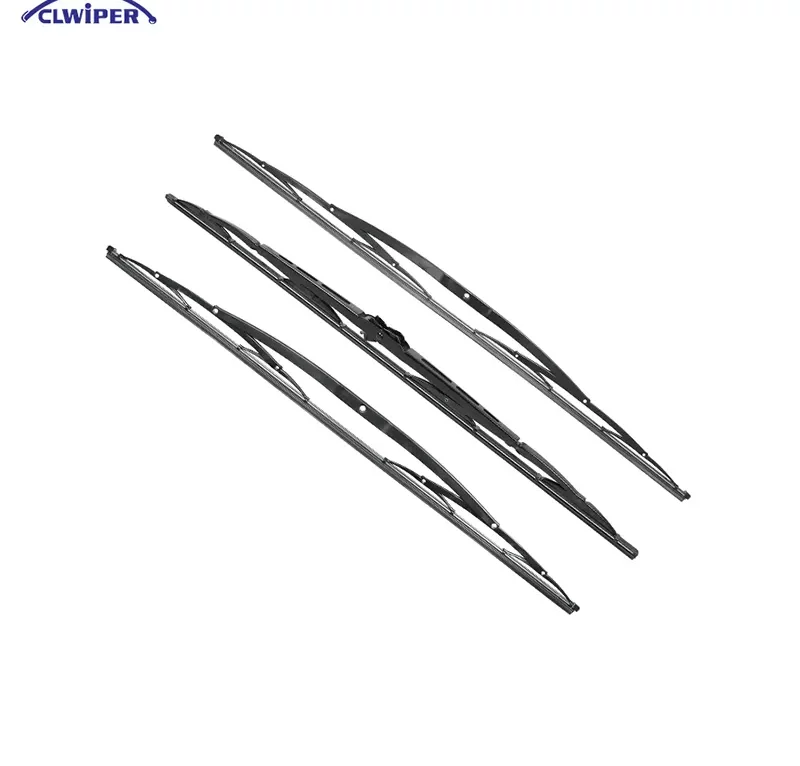
The way rear blades are described on the shop side reflects that: IL rear blade range is presented as being engineered for the particular rear arms different brands use, rather than as a shortened version of a front blade.
How Can Front and Rear Connections Differ?
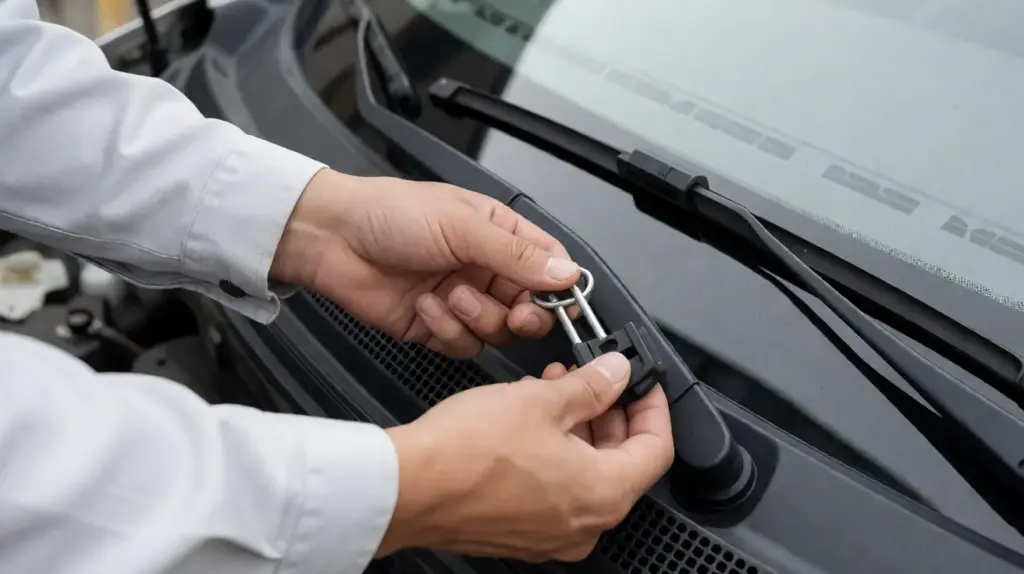
Same connector family, different physical part. That is the part buyers miss. UN “gancio” at the front and a “gancio” at the rear can share a name and still be incompatible, because the wire diameter, the depth of the hook and the closing mechanism differ between positions.
| Where the difference shows up | What it looks like on the rear | Why a front blade fails there |
|---|---|---|
| Position of the joint on the blade | Often close to one end rather than in the middle, so the blade hangs to one side of the arm | A centre-jointed front blade puts its mass in the wrong place and can sit off the glass at one tip |
| Way the lock closes | Small clip, slide-in carrier or a bayonet quarter-turn sized for a short arm | The front adapter may not open far enough, or may close without gripping the thinner arm tip |
| Blade body around the joint | Moulded housing or a spoon-shaped carrier that carries the element and the pivot together | There is no channel to accept a separate front blade, so the whole rear unit is the spare part |
| Included hardware | A single specific adapter, sometimes no adapter at all | Multi-adapter front kits assume windscreen arms; the extra pieces do not add a rear fitment |
The connector types themselves are catalogued in our guide to wiper blade connections, and this article does not repeat it. What matters here is narrower: when you compare a front blade to a rear arm, compare the joint position, the closing method and the housing, then decide. If you are already holding a rear blade that will not lock, the fitment faults in our replacement guide are the place to work through it.
What Else Can Prevent a Blade from Working on the Rear Window?
Even when the connection physically closes, four rear-specific conditions decide whether the blade wipes. Do not generalise from one vehicle to a category here; these are checks, not predictions.
Travel clearance. Rear wipers often stop against a spoiler lip, a defroster line edge or the moulding at the base of the glass. A blade that is longer than the original can foul at the end of travel, and the usual first symptom is noise or a jumped line at one edge of the sweep rather than overall streaking.
Park position and arm geometry. On some tailgate designs the arm parks against the glass under a cover; on others it sits in open air. A front blade with a taller profile can hold the arm off the glass at rest, and the sweep starts with the element not seated.
Glass curvature and contact. Rear windows are more strongly curved than windscreens. Blade bodies tuned for a flatter front glass may contact along only part of their length, which is why a short blade that “fits” can still leave a smearing band.
System load. A heavier assembly, a longer lever arm, or a blade that binds increases the work the rear motor and linkage have to do. Where the arm, linkage or motor is involved, get it checked properly rather than compensating by bending parts or swapping components repeatedly. Nostro wiper FAQ page covers the general symptoms of a system that no longer clears the glass.
Written rules are no help on this question, which surprises many buyers. The GB requirements for wipers and washers are drafted around the windscreen and its visibility: every vehicle fitted with a windscreen needs efficient automatic wipers, and anything fitted must be “properly adjusted and maintained in efficient working order” (GOV.UK summary of the requirements). The US federal wiper standard is written the same way, specifying requirements for windshield wiping and washing systems on passenger cars, multipurpose passenger vehicles, trucks and buses (49 CFR 571.104). Neither text makes front and rear parts interchangeable, and neither publishes a size you can transfer between positions. Compatibility comes from the vehicle and the product’s application data.
When Can the Same Blade Be Used for Both Positions?
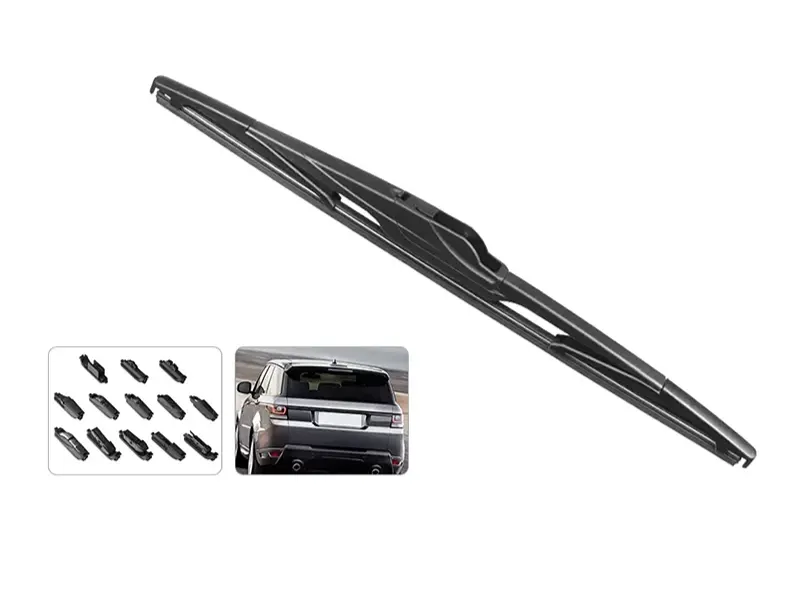
There are three honest cases.
Case 1: the vehicle uses a plain hook arm at the rear and a short conventional blade. Some rear arms are small hooks, and a short frame blade with the same hook footprint can work there. Even then, the length must suit the glass and the blade must clear the spoiler through its travel.
Case 2: the product’s application list names the rear position. Where a SKU is documented for both positions, use it and keep the record. Rear SKUs that carry a broad fitment claim, such as the rear blade listed for 95% di auto, still describe connector coverage for a rear arm; they are not permission to move a front blade to the back.
Case 3: the rear unit is sold as an assembly that happens to share an element. Some rear blades use the same rubber profile as a front design while keeping their own carrier and pivot.
Everything else is “it clicked”, and clicking is not confirmation. A blade that fastens but fouls, floats off the curve at one tip, or shifts the park position has not been fitted; it has been attached. If a rear position needs a documented substitute, treat the search as an application question and check the length guidance in how to choose the right rear blade size alongside the arm photo.
For distributors and resale buyers there is a second reason to insist on the record rather than the click. A rear position fitted from a front SKU produces a return that reads as “the blade does not wipe”, and the fault is in the application decision, not in the rubber. When you publish a listing, the fields worth capturing are the same four the check needs: position, arm end, body style and market, together with the evidence source. That is also what makes a “no” answer credible to a customer who wanted the swap to work.
How Do You Find the Correct Rear Replacement?
Work through the fields in this order, and stop as soon as one is missing.
- Identify the vehicle precisely. Make, modello, model year, stile del corpo (hatch, wagon, SUV, van) and market. The same model in two markets can carry a different rear arm.
- Take the old unit off and photograph it. One photo of the blade flat, one of the joint where it meets the arm, one of the arm tip alone. This settles more questions than any length chart.
- Read the OE number if there is one. A part number on the rear assembly is the fastest cross-reference; note it exactly, including any suffix.
- Measure the element, not just the blade. Confirm length plus the profile if you intend to source a refill rather than the unit. The fields to capture are in the refill measurement guide.
- Check the installation route before buying. If the rear blade sits behind a cover or requires the arm to be positioned in a service angle, read how to change a rear wiper blade first so you know whether you need the assembly with its carrier.
A short rear product such as the 14-inch rear blade with washer shows the other reason position data matters: some rear designs integrate fluid delivery into the blade body, and a front blade cannot reproduce that function even when the arm accepts it.
Check a Rear Application Before You Order

FAQs About Front and Rear Wiper Compatibility
If the length matches, can I swap a front blade to the rear?
Not on length alone. The arm end, the retention method, the joint position on the blade and the travel clearance at the rear all have to suit the tailgate. Length is the first field to check and the least decisive.
Are rear wiper blades universal?
Some rear SKUs cover a wide range of hook-type arms, and it is worth reading that claim as connector coverage rather than as a fitment list for every tailgate. Where the rear arm uses a pin, bayonet or a moulded carrier, coverage narrows quickly, and the vehicle data decides.
Can an adapter solve a front-to-rear swap?
Only for the connection. An adapter can make a joint close; it does not change where the blade’s mass sits, how far it travels, or whether it follows the curvature of the rear glass. If the blade still fouls or floats at the tips, the adapter was not the whole answer.
Why are some rear blades sold as one dedicated unit?
Because the carrier is functional. On a number of designs the moulded body sets the pivot geometry, carries the washer channel, or closes the joint around a short arm. The carrier, element and connector are supplied together because that is how the position is engineered.
Should front and rear blades be replaced together?
Not automatically. The front pair works far more hours and wears faster, while a rear blade on an occasional-use vehicle can stay serviceable longer. Replace by condition, and treat a combined order as a purchasing convenience rather than a maintenance rule.